| Winning Score Prediction | −8 to −12 — cast-iron turf, but only 10–14 mph of wind |
| Primary Skill | Precision from tee to green — controlling the roll, avoiding greenside runoffs |
| Model Favorite | Scottie Scheffler — 1st in Par+, 1st in course fit, off a missed cut |
| Dark Horse | Aaron Rai (+6500) — 2nd on Tour in driving accuracy |
| Best Hole | 17th — par 5, 566 yds, reachable and late |
| Hardest Hole | 1st — par 4, 447 yds, ~4.4 average |
| First Tee (ET) | 1:35 AM Thursday — Peacock from 1:30 |
| Last Winner Here | Spieth, 2017 — −12, soft and calm |
| Hidden Storyline | Shaved runoffs now ring the greens — 2017 course history is stale |
| Question of the Week | Can Fleetwood’s nerve hold on the links he grew up on? |
The final major of 2026, and it lands in the middle of a very loud week for England. Wimbledon has only just packed up its chairs, and on Wednesday night — the eve of the first round — England play Argentina in a World Cup semi-final in Atlanta. Win that, and the final kicks off Sunday, the same afternoon the Claret Jug gets handed over. The Brits are having themselves a moment.
Royal Birkdale in Southport hosts its 11th Open, all of them since 1954, more than any venue outside St Andrews across that span. It arrives with a reputation as the fairest links the Open visits, a course that hands you flat lies and full sight of your targets. A hundred and fifty-six players, a 36-hole cut, par 70 over 7,223 yards.
The story of the week so far is the ground itself: an uncharacteristic hot dry British summer has baked the fairways brown and left them, by most accounts, the firmest they have played since 2018 — caddies reckon they may be running quicker than the greens by Sunday. Jon Rahm has been talking about 6-irons going 280 yards. Michael Kim hit a 4-iron 290 downwind off a tee. Spieth watched a 5-iron run out to 300. We could see some 400-yard drives from Bryson this week, despite the rest of his game being a less than ideal fit.
Scheffler took home the Claret Jug last July but arrives having just failed to make a weekend. He missed the cut at the Scottish Open on Friday — his first missed cut in 78 starts and nearly four years, a streak that had run since August 2022 and stood as the longest in golf since Tiger’s. He remains world No. 1, the favorite in our model and market odds, and the honest read is that one bad Friday is probably noise. Except for one thing…
| Day | TV Coverage (ET) |
|---|---|
| Thu 7/16 | Peacock 1:30–4 AM · USA 4 AM–3:30 PM |
| Fri 7/17 | Peacock 1:30–4 AM · USA 4 AM–3:30 PM |
| Sat 7/18 | USA 5–7 AM · NBC 7 AM–3 PM |
| Sun 7/19 | USA 4–7 AM · NBC 7 AM–2 PM |
Set an alarm or don’t: the first groups go out around 1:35 AM ET Thursday, and Peacock has the early window before USA picks it up. Peacock also carries featured-group feeds all week — more than 300 hours of coverage across NBC, USA, Golf Channel and Peacock. Golf Channel Mobile streams the USA telecasts.
Birkdale is younger as a championship course than its reputation might suggest. The club dates back to 1889, but the layout the professionals play is the product of a 1931 redesign by Frederick Hawtree and J.H. Taylor, a five-time Open winner who spent the back nine of his life shaping courses instead of winning on them. That late modernization is why Birkdale did not host its first Open until 1954, three years after it was granted royal status.
Three generations of the Hawtree family — the oldest design firm in the world — have had their hands in shaping the property, and Martin Hawtree, Frederick’s grandson, rebuilt the 17th green before the 2008 Open. The most recent work was the largest: a 2024 remodel by Tom Mackenzie of Mackenzie & Ebert that touched every hole on the course. He redesigned the short 5th, shortened and rebuilt the par-3 7th, scrapped the old 14th entirely, rebuilt the old 15th into a long par 5 that now plays as the 14th, and carved a brand-new par 3 out of the ground that was left over. Fourteen bunkers came out altogether, replaced with short-cut grass. The brief from the club was explicit: not a restoration, but a course fit for the modern game. More on that shortly.
The Open has no permanent home. It moves among ten links courses — the rota, in the game’s shorthand — and of those ten, Birkdale is the one most often called the fairest. Its dunes are among the tallest and most rugged of the bunch, but the holes run through the valleys between them rather than over their shoulders, and that routing defines the course. Birkdale gives you flat lies, full sight of your targets, and very few of the blind, random bounces that can produce rotten luck at Prestwick or Portrush. What you see is what you get, and what it asks for is straight driving and precise distance control. Luck and local knowledge take a backseat to command of your game.
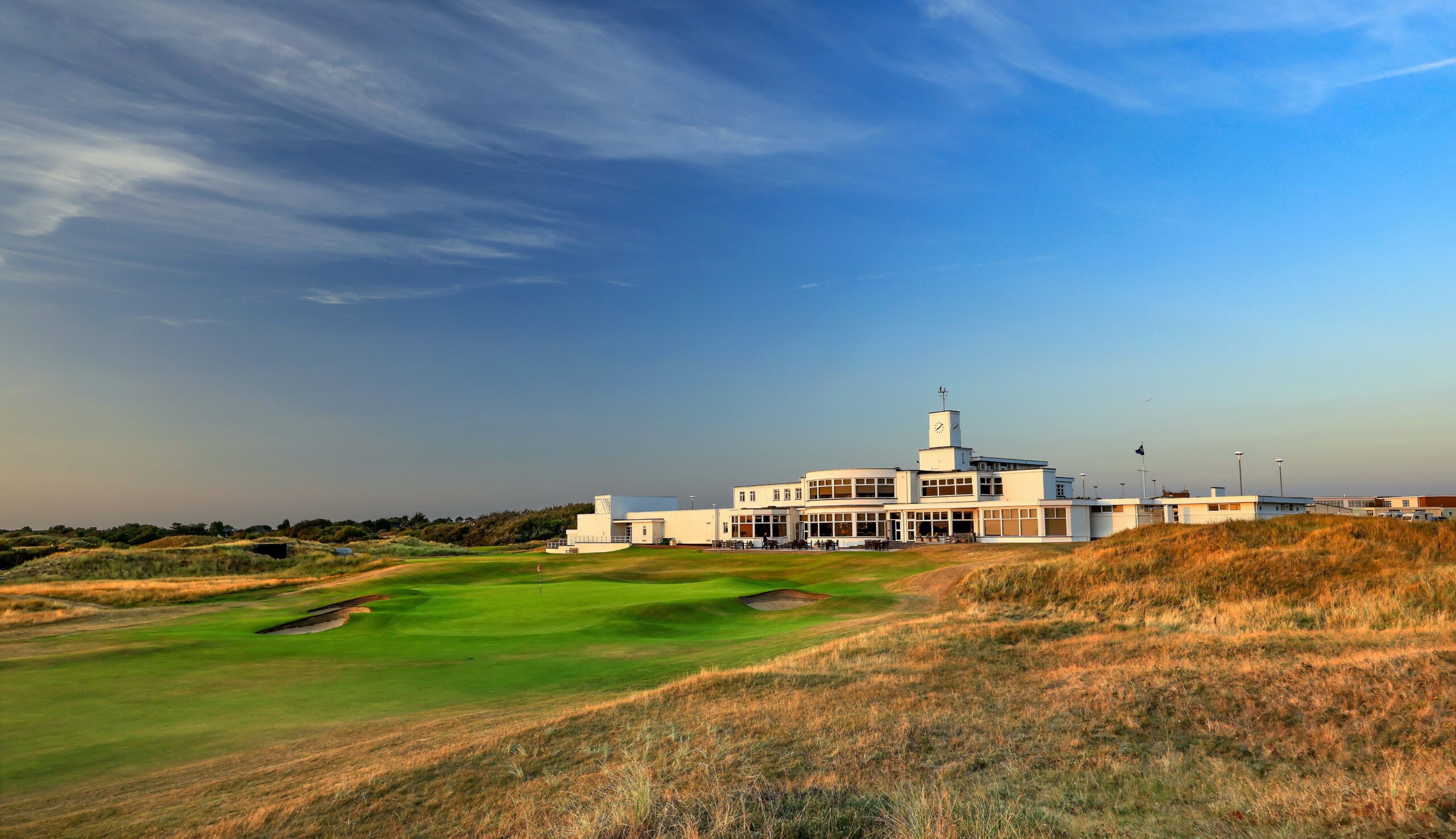
The 18th at Royal Birkdale, with the clubhouse standing behind the green.
None of this is accidental. In fact, the club is contractually forbidden from letting the major quality conditions slip. Championship status is written into Birkdale’s lease — the club is obliged to maintain a course capable of hosting the game’s biggest events. That clause is why Mackenzie was hired. A course built in 1931 to be a championship venue is, ninety-five years later, still legally required to be one.
Birkdale rewards the best. Its list of champions reads like a shortlist of the era’s finest ball-strikers — Thomson, Palmer, Trevino, Miller, Watson, O’Meara, Harrington, and, in 2017, Jordan Spieth. There is a reason for that consistency. When a course removes trickery, lousy ball-striking has nowhere to hide and no one to hide behind.
Open championship golf resists the tidy statistical portrait you can build for Augusta, because the wind rewrites the test hour to hour. But Birkdale’s honesty narrows the profile more than most links do. These are the filters that matter here.
Where the Claret Jug gets won, and one hole nobody has ever played in an Open.
Walk all 18 with the official hole-by-hole guide → from the R&A, golf’s governing body outside the United States and the organization that runs the Open.
The rudest welcome in the rota. A penal bunker cut into the face of a mound on the left pinches the fairway just where you want to land it, and out-of-bounds runs the entire right side. Most players won’t risk driver, which leaves a long, semi-blind approach to a green fronted by two pot bunkers. Nearly 4.4 strokes a round over the last three Opens. Par is a great start.
Birkdale’s problem child — short, awkward, a pond that never belonged, and wet ground that kept it in poor condition. Mackenzie reimagined it in place. It is 25 yards shorter, the green has been moved up and left so it is visible from the tee, and new bunkering now bites whether you lay up or go. It reads drivable on the card, but it plays into the prevailing southwesterly, which is the wrinkle: the yardage invites the driver but smart golf says take the iron.
Open theater doesn’t get stranger than what happened here in 2017. Spieth classically flared his final-round drive so far right it came to rest on the shoulder of the dunes, 70 yards off the fairway. Twenty-nine minutes and several rulings later he walked off with a bogey — and then went birdie, eagle, birdie, birdie to win. The fairway has been widened toward the left ditch since, but it still favors a drive that hugs the right bunkers, and the enlarged area left of the green punishes the bailout.
A hole no one has ever played in an Open. Mackenzie built it in 2024 to give Birkdale the long par 3 it lacked, slotting it between the old par-5 15th (now the 14th) and the par-4 16th after the previous short 14th was converted into a practice area. It typically plays downwind, and it is the only short hole here you can run a ball onto — a ground-game option that did not exist on any of the old par 3s. At 241 yards to a deep, angled green guarded left by two pot bunkers, the up-and-down from the sunken short grass on the right will be the difference. Mackenzie calls it the change he is proudest of.
The subtle one, and the clearest window into what the remodel was for. The 12th used to sit behind four bunkers in a square — two right, two left. Mackenzie took the left pair out entirely and left shaved ground in their place. Miss the green short or left now and the ball runs 20 or 30 yards back off the putting surface, into a recovery that is harder than the bunker shot it replaced. The right side, meanwhile, got guarded more stoutly. The hole is easier for a member and meaner for a professional, which was precisely the brief.
The one that keeps everyone honest. The fairway snakes right to left through a valley of willow scrub, and long hitters can shave the corner by carrying the bunker in the left rough. The green — rebuilt by Martin Hawtree before 2008 — is the most contoured on the course, rising in steps into an amphitheater of dunes that will hold the loudest gallery on the property come Sunday. A reachable par 5 as the 71st hole is exactly the kind of lever a links Open turns on.
Tommy Fleetwood back in the town that already painted his face on a wall. Fleetwood grew up in Southport just a few miles from the course, and the town has spent the spring turning his homecoming into an event of its own — a mural near the course, a fan hub in his name, the works. He calls the Open the tournament he “dreams the most of.” He broke through for his first PGA Tour title at the Tour Championship last year, which quieted the tired “best player without a win” line, but a major is the next step for Tommy. He enters the week in fine form with a T13 at the Scottish Open last week. The model is far more enthusiastic than the market: second-best course fit in the field. Whether the weight of the homecoming is fuel or ballast is something to watch.
Scottie Scheffler ran off with the Claret Jug at Portrush last July by four, added the 2025 PGA, and still sits at world No. 1. What he still does not have is a U.S. Open, and a T4 at Shinnecock last month left the career Grand Slam on hold until at least 2027. Then last week he missed a cut — his first in 78 starts and nearly four years, undone by a 72 on Friday and an uncooperative putter. It is the first crack anyone has seen in him since 2022, and it is almost certainly noise. His tee-to-green game remains the best in the world by a margin.
Rory McIlroy, feeling free and dangerous. A second straight Masters in April, a T7 at Aronimink, a U.S. Open weekend that got away, and now a T7 at the Scottish Open with a closing 66 — he is arriving to Southport, quietly, in shape. He finished T4 the last time the Open came to Birkdale in 2017 and T7 at Portrush last year. With the Grand Slam monkey off his back, his links game — when the driver behaves — is as suited to Birkdale’s demand for controlled power as anyone’s in the field.
Aaron Rai gets his home Open. In May, Rai became the first Englishman to win the PGA Championship since Jim Barnes in 1919, closing his final ten holes brilliantly at Aronimink in six under to beat Jon Rahm and Alex Smalley by three. He followed it with a T11 at Shinnecock. He is second on Tour in driving accuracy, which is the trait this course prizes above all others — though, as we get into below, our own model is unconvinced by the rest of his profile. An English major champion, at an English Open, at 65-to-1.
The links horses came out of Scotland hot. Tom Kim won the Scottish Open at 17 under, with Robert MacIntyre and Matt Fitzpatrick tied third. Those are the three most relevant form lines in the field, because coastal wind is the one condition that does not travel from a parkland résumé. Fitzpatrick’s week cut his price from +2000 to +1500. Kim’s barely moved his at all — which is the sort of thing our model has opinions about.
Chris Gotterup is the real deal. Twelve months ago he joined the elite players discussion. He won the Scottish Open, beating McIlroy by two, then walked into Portrush the following week for his first Open Championship and finished third. He has three PGA Tour wins now, sits seventh in the world, went T11 at the Renaissance Club last week, and Par+ has him 14th. The one hesitation is a real one: his course fit grades 43rd, because his game leans on power and Birkdale is more of a precision test. Baked ground and a soft breeze may nullify his primary skillset.
The market has this as a two-man race at the top and a crowded, live middle underneath. The table below is the current market picture. The Par+ column is where our model’s number goes once the field and inputs are locked — fill these in from the live model before sending.
| Par+ | Player | Strokes | Course Fit | Market |
|---|---|---|---|---|
| 1 | Scottie Scheffler | +1.90 | 94.6 (#1) | 12.5% |
| 2 | Rory McIlroy | +1.58 | 70.3 (#17) | 11.1% |
| 3 | Matt Fitzpatrick | +1.54 | 89.9 (#3) | 5.9% |
| 4 | Tommy Fleetwood | +1.45 | 91.0 (#2) | 5.7% |
| 5 | Jon Rahm* | +1.32 | 65.0 (#28) | 4.9% |
| 6 | Wyndham Clark | +1.29 | 82.0 (#8) | 3.0% |
| 7 | Tom Kim | +1.21 | 86.0 (#4) | 1.7% |
| 8 | Viktor Hovland | +1.17 | 72.3 (#15) | 3.1% |
| 9 | Patrick Cantlay | +1.14 | 81.6 (#10) | 1.6% |
| 10 | Si Woo Kim | +1.12 | 75.9 (#12) | 2.0% |
Par+ is expressed as strokes better than field expectation. Course Fit is a 0–100 percentile against this field, weighted for Birkdale (driving accuracy, wind-adjusted approach, bogey avoidance). Market = implied win probability from consensus sportsbooks, Monday of Open week. Green marks players the model rates materially higher than the board does. *LIV player — 33% stat coverage; scored on available inputs only.
The model isn’t panicking. Scheffler missed a cut for the first time in four years and Par+ still has him first by a country mile, at +1.90 strokes on the field, with the best course fit of all 141 players at 94.6. Every underlying rating still comes back elite — ball-striking, short game, closing, floor. One bad Friday in Scotland moved the market from +500 to +700. It moved the model not at all. The model doesn’t capture confidence, so the number could still be a tough high.
Tommy Fleetwood grades out with the second-best course fit in the field (91.0), fourth in Par+, and the two ratings that Birkdale now leans on hardest — short game and bogey avoidance — both come back above average. The market spent last week pushing him out from +1400 to +1800 on the strength of a T13. The model looked at the same week and kept him fourth. The board moves on form and the model holds on fit, at the one course on earth he knows best.
Where the board looks stretched: Bryson DeChambeau is priced 18th but grades 69th in course fit, a power-over-precision profile aimed at a course that pays for the opposite. Justin Rose and Jordan Spieth carry similar gaps — names the market pays for and the fit does not support.
There is a semi-final on Wednesday night and a first tee time at 1:35 on Thursday morning. We contain multitudes.
| Player | Country | Note |
|---|---|---|
| Scheffler | France | The machine. Deepest squad, ruthless, keeps it simple and plays the right way. |
| McIlroy | Brazil | Flair and capable of highlights — and a history of heartbreak nobody wants to revisit. |
| Fitzpatrick | Belgium | Organized, disciplined, impossible to break down. Wins by refusing to lose, and never apologizes for it. |
| Fleetwood | England | Adored at home, forever in the semi-final, still waiting. Waiting for it to come home. |
| Rahm | Spain | Technical, intense, no nonsense. |
| Clark | USA | Athletic and streaky. Capable of beating anyone, and of losing to anyone. |
| Tom Kim | Morocco | Fearless competitor. Entirely unbothered by the badge on the other shirt. |
| Hovland | Norway | Obvious one. A bit one-dimensional, but a weapon or two away from ascension. |
| Cantlay | Germany | Efficient, methodical, unbothered. Will beat you 1–0 and never change expression. |
| Si Woo Kim | Netherlands | Technically gorgeous and gifted, curiously short of trophies. |
He won this championship at St Andrews in 2022 and the world has more or less stopped thinking about him. He is ranked 138th now, priced 39th here, and carries the one rating that matters most at the new Birkdale: a short game graded 94.5, Elite — the best in this section by a distance. Mackenzie tore 14 bunkers out of the green surrounds and laid shaved grass in their place specifically to punish players who cannot chip off a tight lie. Smith is arguably the finest tight-lie chipper alive. His ball-striking numbers are thin and unflattering, and the LIV sample is small enough to distrust. But the specific skill this specific course now demands is the one thing he has never lost.
Not English, but the surname can’t hurt. Twelve months ago he finished second in this championship, four back of Scheffler at Portrush, and it is genuinely difficult to find anyone discussing him coming into the week. Par+ has him 30th and course fit 18th, with an above-average short game — the profile of a man who does not beat himself. English is a plodder in the best sense: he keeps the ball in front of him, avoids the card-wrecking hole, and is still standing on Sunday while flashier players are explaining what went wrong. The board has him 35th. Last year’s runner-up is not usually a 35-to-1 proposition.
He is the living proof of the pattern above. Harman went T12 at the Scottish Open in 2023, walked into Hoylake the following week, led from Friday and won the Claret Jug by six. Nobody saw it coming then either. The model, it should be said, sees nothing coming now: course fit 49th, overall rating 25.9, and — with a straight face — a closing rating of 15, Weak, for a man who has already led an Open wire-to-wire. That is what two years of mediocre form does to a number. But his irons have quietly come back (+0.55 strokes on approach over his last 24 rounds), he is a left-hander who has never needed length, and this is a championship that has already, once, handed itself to exactly this player having exactly this kind of year.
And one the model wants no part of. Lowry is the 2019 Open champion and the field’s clearest example of a man the weather cannot rattle — when it turns ugly and the rest of the field starts protecting scores, he is at his most dangerous. Par+ has him 24th, which is respectable. Course fit has him 31st, which is not, and it rates his short game below average, which at a course now ringed with shaved runoffs is the wrong weakness to bring. The numbers say middling. The pedigree says he has already sat on a lead in this championship and not flinched. If the forecast turns, take the pedigree.
*LIV player — 30% stat coverage. Scored on available inputs only, so read the ball-striking ratings with appropriate suspicion.
The most recent Open at Birkdale is the obvious reference, with one large caveat: it was soft. Spieth won at 12 under, a number that reflects a week of receptive greens and holdable approaches more than it reflects a firm, fast Birkdale in full defensive teeth. Expect compression if the Irish Sea breeze arrives and the turf dries out.
There is a second caveat, and it matters more than the first. The course has been rebuilt since. Mackenzie touched every hole, rebuilt at least half the bunkers, reshaped the green surrounds, and added a par 3 that did not exist. The green surrounds are the crucial part: they were compact and tight against the dunes in 2017, and they are shaved runoffs now. Which means the scrambling and short-game numbers from Spieth’s week describe a golf course that is no longer there. Anyone leaning on 2017 course history to handicap this field is reading an old map.
What travels from 2017 is the shape of the finish. Spieth’s closing run — a bogey salvaged from the dunes on 13, then birdie, eagle, birdie, birdie across 14 through 17 — is a reminder that Birkdale’s back nine hands out chances late to the player still swinging freely. The two par 5s and the reachable corners give the closer a path. The 1st and the long par 3s take it away from the tentative.
| Year | Champion | Score |
|---|---|---|
| 2017 | Jordan Spieth | 268 (−12) |
| 2008 | Pádraig Harrington | 283 (+3) |
| 1998 | Mark O’Meara | 280 (playoff) |
| 1991 | Ian Baker-Finch | 272 |
| 1983 | Tom Watson | 275 |
| 1976 | Johnny Miller | 279 |
| 1971 | Lee Trevino | 278 |
| 1965 | Peter Thomson | 285 |
| 1961 | Arnold Palmer | 284 |
| 1954 | Peter Thomson | 283 |
Note the range: Harrington won at +3 in a gale in 2008; Spieth at −12 in soft 2017. Same course, fifteen shots apart. The wind writes the winning score.
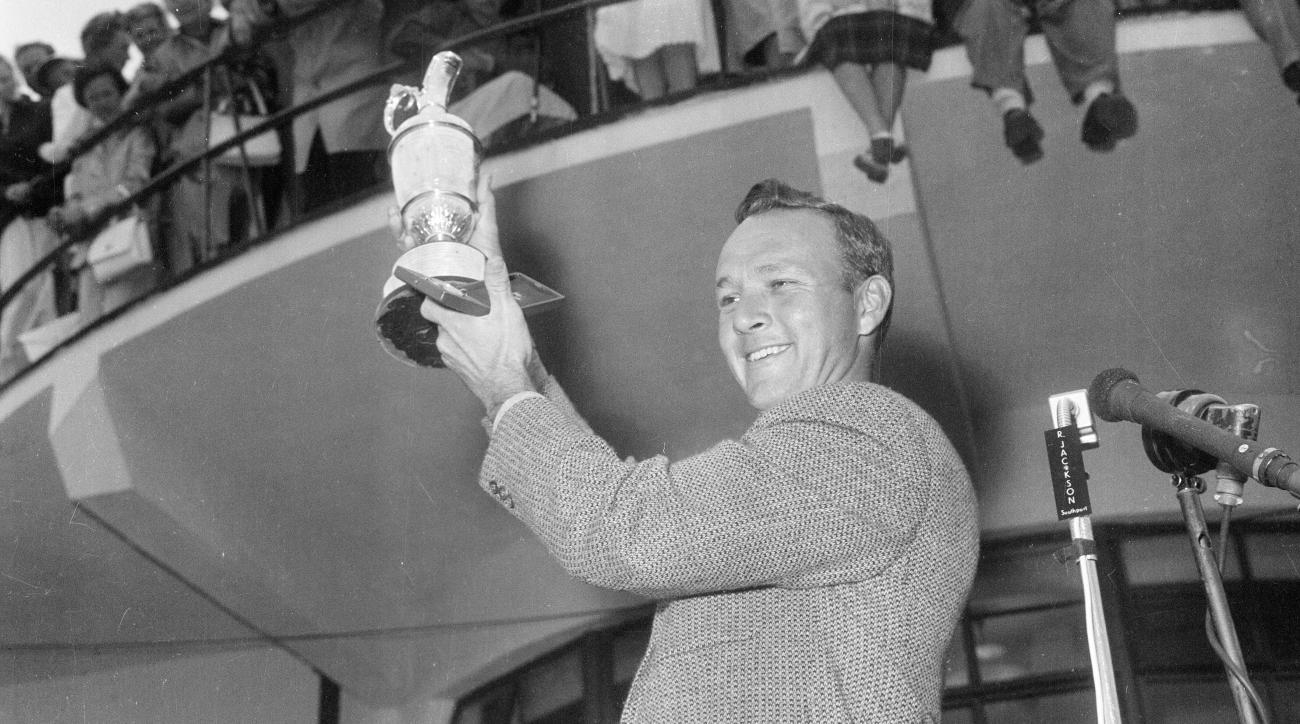
Arnold Palmer at Birkdale, 1961 — the first of his two straight Opens. His decision to cross the Atlantic and play the championship is widely credited with reviving it for a generation of Americans who had stopped bothering.
Birkdale’s reputation as the honest links cuts a direction most people miss. Fairness sounds like it should widen the field — no blind bounces, no unlucky kicks, everyone gets what they earn. In practice it does the opposite. Courses with quirk and blindness inject randomness that lets an inferior ball-striker steal a week on the right bounces. Strip that out, as Birkdale does, and the noise that helps the long shot disappears with it.
That is why the champions’ list here is so top-heavy with the era’s best strikers. Birkdale defends itself off the tee and around the greens, but never on them: miss the corridor and the scrub swallows you, miss the surface and the shaved runoff drags you 30 yards from the hole — yet reach the putting surface and it gives back nothing a hot week with the putter could disguise. Skill is examined everywhere except the one place where luck usually hides. When a course removes that, the leaderboard settles closer to true talent than it does anywhere else in the rota, and the upset that Portrush or Prestwick can manufacture is harder to pull off here.
What this means for picks and viewing: be more skeptical of the pure long-shot flyer than you would be at a quirkier links. The value here isn’t the 150-1 who catches lightning on a bounce — Birkdale does not hand out bounces. It is the mispriced quality in the middle of the board: players whose games fit the examination and whose prices reflect a narrative discount rather than the golf. Fleetwood at 18-1 after a shrug of a week in Scotland. Rai, a major champion this season, at 65-1. MacIntyre, in links form, on links ground. Fit first, story second.
The forecast is the whole tournament here. A firm, breezy week pushes the winning score toward single digits and rewards the flighted ball and the patient card; a soft, calm week — as in 2017 — opens scoring into the teens and favors the aggressor. Watch the Thursday–Friday wind direction: an onshore Irish Sea breeze changes which holes bite.
Keep an eye on it. Firm and breezy pushes the winning score toward single digits and rewards the flighted ball and the patient card. Soft and calm — as in 2017 — opens scoring into the teens and favors the aggressor. This week is the third combination, and the rarest: firm and calm, which is how Hoylake gave up 18 under in 2006. Watch the Thursday–Friday wind direction — an onshore Irish Sea breeze changes which holes bite.
| Day | High | Wind | Conditions |
|---|---|---|---|
| Thu 7/16 | 82°F | 8–14, gusts 20 | Sunny, warm, dry |
| Fri 7/17 | 77°F | N 8–14 | Cloud, slight shower chance |
| Sat 7/18 | Warm and predominantly dry | ||
| Sun 7/19 | Warm and predominantly dry | ||
The oddity of this Open is that the sky is the friendly part and the ground is the enemy. Practice rounds saw gusts to 28 mph; the championship days look calmer than that. No weather is coming to defend this golf course.
Morning versus afternoon draw can be worth a stroke or two a day if the wind builds after lunch. Worth tracking early — the players who catch the benign half of a split draw bank a cushion before the course tightens.
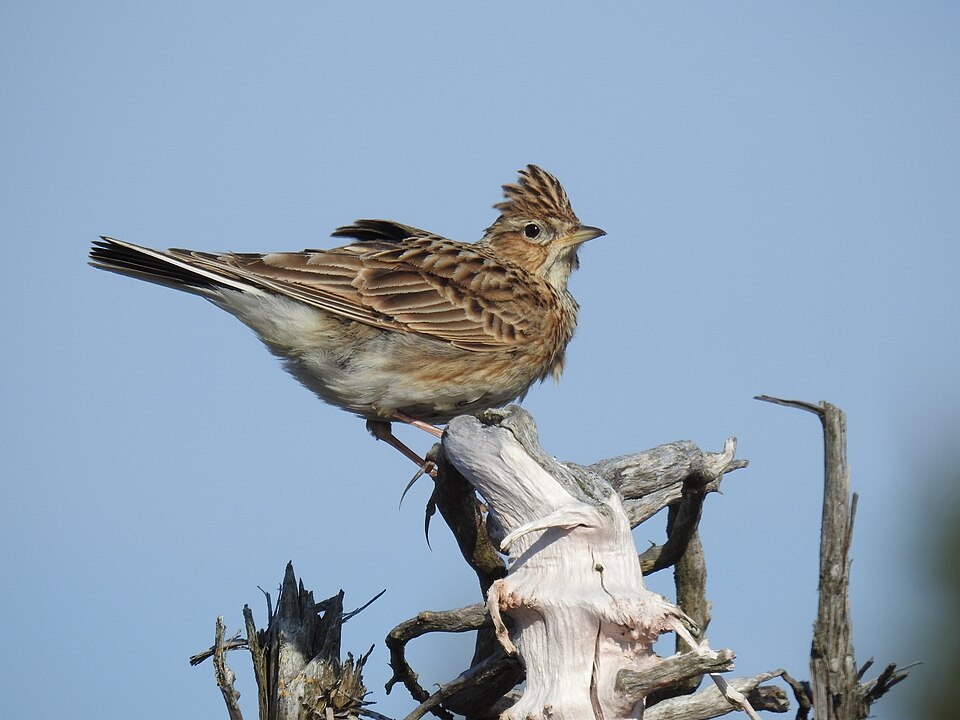
Each week, a bird native to the tournament’s corner of the country.
Sources: The R&A / The Open · Royal Birkdale Golf Club · Golf Digest (Derek Duncan) · The Fried Egg · Tom Mackenzie / Mackenzie & Ebert (Q&A) · Wikipedia · Golf Channel · CBS Sports · PGA Tour · PGA Championship · Golfweek · Golf Monthly · Today’s Golfer · Yahoo Sports · The Mirror · Golfmagic · Oddschecker / FanDuel · Sefton Coast (Dynamic Dunescapes, RSPB Liverpool, Sefton Council) · Cornell Lab of Ornithology